
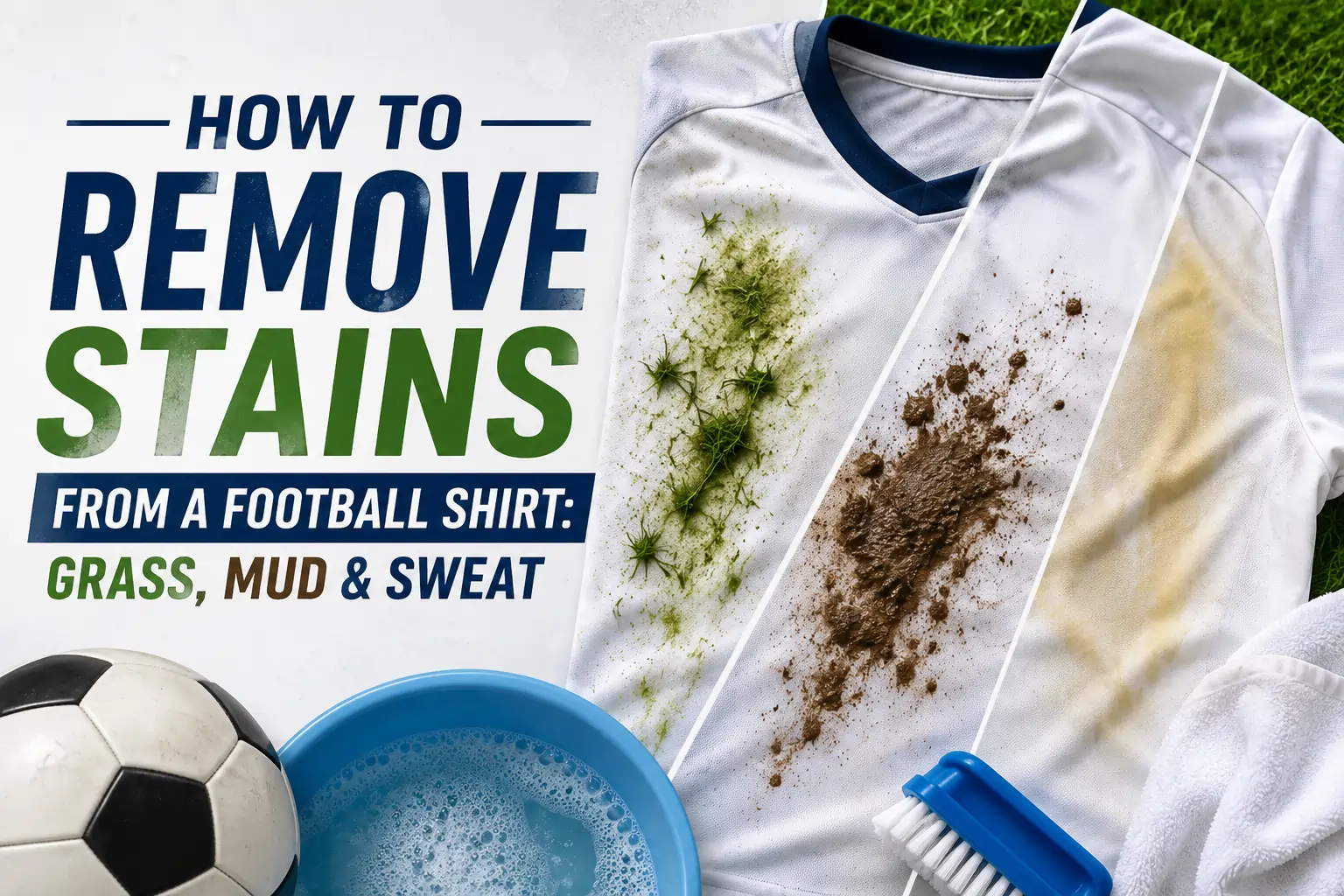
Anyone who has ever played a game of football knows the feeling of pulling off a stained shirt after the final whistle. Grass streaks down one side, mud caked across the front, and sweat marks that never quite seem to shift. The good news is that most football shirt stains can be removed completely if you act quickly and use the right approach. This guide walks you through how to tackle the three most common culprits, grass, mud, and sweat, without damaging the fabric or the printed badge, name, and number.
Why Football Shirts Stain So Easily
Football shirts are made from engineered polyester, a fabric built to wick sweat and dry fast. That performance comes with a small trade-off. Polyester can hold onto oils, body odour, and certain pigments more stubbornly than natural fibres, which is why sweat marks in particular can linger. Grass and mud, meanwhile, contain natural dyes and fine particles that work their way into the weave during a match.
The key thing to understand is that the fabric itself is fairly resilient, but the printing is not. Names, numbers, and badges are usually heat-pressed transfers, so any stain treatment needs to be gentle around those areas. With that in mind, let us look at each stain type in turn.

The Golden Rules of Stain Removal
Before we get into specifics, a few principles apply to every stain.
Act fast. The sooner you treat a stain, the easier it lifts. A fresh mark comes out far more readily than one that has been left to set for days.
Always use cool or lukewarm water, never hot. Heat can set stains permanently and can also soften the adhesive behind printed transfers.
Blot, do not rub. Rubbing pushes the stain deeper into the fibres and can damage both the fabric and the print. Dab gently from the outside of the stain inwards.
Test any product first. Before applying a stain remover, test it on a small hidden area, such as an inside seam, to make sure it does not affect the colour.
Keep treatments away from the print. Whenever possible, work around the badge, name, and number rather than directly over them.
How to Remove Grass Stains
Grass stains are among the most common and the most stubborn, thanks to the natural pigments in the blades. Start by brushing off any loose, dried grass. Then dab the stain with a little mild liquid detergent or a mix of water and white vinegar, working it gently into the mark with your fingers or a soft brush.
Let it sit for around fifteen minutes so the solution can break down the pigment. For tougher grass stains, a paste of bicarbonate of soda and water can help lift the colour without harsh chemicals. Once treated, rinse with cool water and wash the shirt as normal on a cool cycle. Avoid bleach entirely, as it will damage the fabric and strip colour from both the shirt and any printing.
How to Remove Mud Stains
Mud is easier to deal with than people expect, and the biggest mistake is trying to clean it while it is still wet. Wet mud smears and spreads deeper into the fibres. Instead, let the mud dry completely, then brush or scrape off as much of the dried dirt as you can.
Once the loose mud is gone, dab the remaining mark with mild liquid detergent and a little cool water. Gently work it in and let it soak for ten to fifteen minutes. Rinse from the back of the fabric to push the stain out rather than through, then wash on a cool cycle. Repeat the treatment before drying if any mark remains, since heat from drying can lock in whatever is left.
How to Remove Sweat Stains and Odour
Sweat is the stain that troubles polyester most, because it leaves behind oils and salts that build up over time and cause both marks and lingering smells. To tackle it, soak the shirt in a solution of cool water and white vinegar, roughly one part vinegar to four parts water, for around thirty minutes before washing. Vinegar breaks down the residue that ordinary detergent leaves behind.
For stubborn odour, a paste of bicarbonate of soda applied to the affected areas and left for fifteen minutes works well. Both are gentle, print-safe, and far kinder to performance fabric than harsh chemical treatments. Wash on a cool cycle afterwards, and always skip fabric softener, which coats the fibres and traps odour rather than removing it.
Drying After Stain Removal
Once your shirt is clean, how you dry it matters. Check that the stain has gone before drying, because the heat of a tumble dryer can set any remaining mark permanently. If you can still see a trace, treat and rinse again first.
When the shirt is fully clean, air dry it. Hang it up or lay it flat, and keep it out of harsh direct sunlight, which can fade both the colour and the print. Never tumble dry a football shirt, as the intense heat damages transfers and can shrink the polyester. Air drying is quick anyway, thanks to the fabric’s low water absorption.
Common Mistakes to Avoid
A few quick reminders bring it all together. Never use hot water, never use bleach, and never scrub hard over printed areas. Do not tumble dry until you are certain the stain is gone, and do not leave a sweaty, muddy shirt screwed up in a bag after a match, which gives stains and odours time to set. Avoid these and your shirt will come up clean time after time.
Keep Your Kit Looking Its Best
With a little care and the right technique, grass, mud, and sweat are no match for a quick, gentle treatment. Act fast, keep the water cool, work around the print, and air dry, and your shirt will stay looking sharp season after season. For more care advice, take a look at our guides on how to wash a football shirt without ruining the print and football shirt materials explained.
Looking for a fresh addition to your collection? Browse our full range of international football shirts and retro football shirts, all made from quality breathable polyester and built to last.
Leave A Comment