
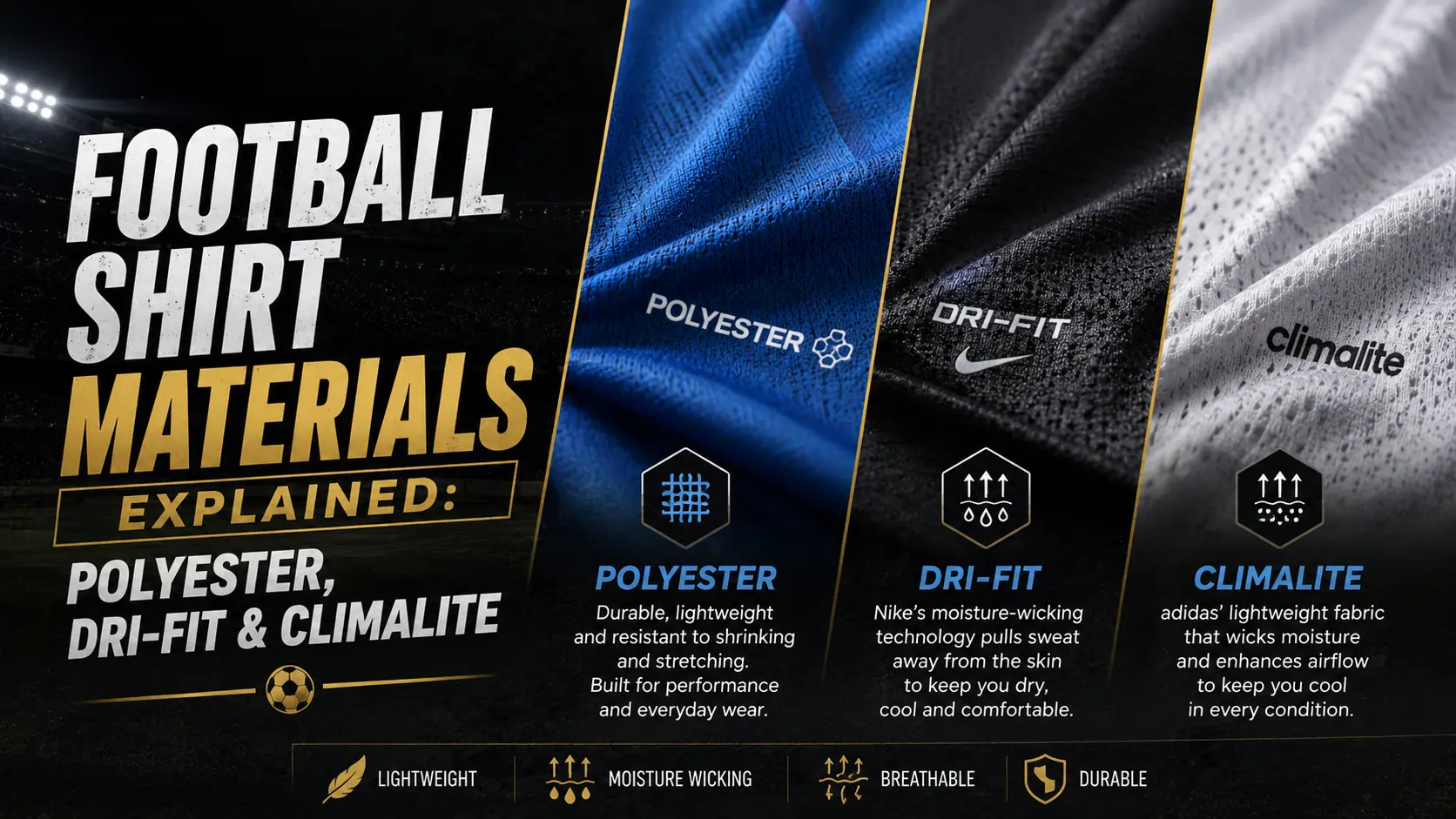
If you have ever shopped for a football shirt, you have probably come across terms like polyester, Dri-FIT, and Climalite without ever being told what they actually mean. They get printed on labels and dropped into product descriptions as if everyone already knows the difference. The truth is that the material your shirt is made from has a real impact on how it feels, how it performs, and how long it lasts. A good fabric can be the difference between a shirt that keeps you cool and comfortable through ninety minutes and one that leaves you hot, heavy, and soaked in sweat. In this guide we break down the most common football shirt fabrics in plain English, so you know exactly what you are buying and why it matters.
Why Shirt Material Matters
A football shirt is not just about looking the part, although that certainly counts for a lot. It also has a job to do. During a match or a kickabout you sweat, you move constantly, and your body heats up fast. The right fabric helps move that moisture away from your skin, keeps you cool, and dries quickly so you are not left wearing a damp, clinging shirt by half time. The wrong fabric does the opposite, soaking up sweat and holding it against your body, which leaves you uncomfortable and weighed down.
This is why almost every modern football shirt has moved away from cotton and towards engineered synthetic fabrics. Decades ago, classic shirts were heavy cotton numbers that became waterlogged in the rain and clung to players by the final whistle. You can still see that old-school charm in our retro football shirts, though even many of those now use modern fabrics. Today’s shirts are lightweight, breathable, and built for performance. Understanding the difference between the materials helps you pick a shirt that performs well, whether you are playing five-a-side on a Sunday, training during the week, or simply wearing it to support your team from the stands.
Polyester: The Foundation of Every Football Shirt
Polyester is the base material for virtually all modern football shirts, and for good reason. It is a synthetic fabric that is lightweight, durable, and naturally good at managing moisture. Unlike cotton, which soaks up sweat and holds onto it, polyester barely absorbs any water at all. To put some numbers on it, cotton can hold up to seven percent of its weight in water, while polyester holds less than half a percent. That single difference is exactly why a polyester shirt dries so much faster and feels so much lighter during play.
The benefits are easy to feel when you wear one. Polyester is breathable, quick-drying, and holds its shape and colour well wash after wash. It resists wrinkling, fading, and shrinking, so your shirt looks fresh for far longer than a cotton equivalent would. It is also strong and hard-wearing, which means it stands up to regular matches, washes, and general use without falling apart at the seams. For an item that gets put through as much punishment as a football shirt, that durability really matters.
Every football shirt at SoccerLord is made from breathable, performance-grade polyester. That gives you the lightweight feel and quick-drying comfort you want from a match shirt, at a price that does not break the bank. When people talk about Dri-FIT or Climalite shirts, they are really talking about specific branded versions of engineered polyester. Understanding that connection is the key to making sense of all the marketing jargon, so let us look at each one in turn.
What Is Dri-FIT?
Dri-FIT is not actually a separate material. It is a moisture-control technology developed and trademarked by Nike, built on top of polyester. The idea behind it is to take standard polyester and engineer it further to improve the way it handles sweat, then attach a recognisable brand name to that refinement.
It works through what is known as moisture wicking. The fabric uses fine polyester microfibers, much thinner than a strand of silk, treated with a water-repelling, or hydrophobic, finish. Instead of absorbing your sweat, the material pulls it away from your skin and spreads it across the surface of the shirt, where it can evaporate quickly. The result is that your skin stays drier and cooler for longer, and you avoid that sticky, clinging feeling during intense activity. Some Dri-FIT garments also add a small amount of spandex for stretch, along with mesh panels at key points like the underarms to boost airflow where you need it most.
Because it is a Nike technology, true Dri-FIT is found on official Nike products. The important thing to understand as a shopper is that Dri-FIT is essentially a refined, branded form of the same polyester that underpins all performance shirts. The core material is the same. What you are paying extra for is the specific brand name and its particular fibre engineering.
What Is Climalite (and Climacool)?
Climalite is adidas’s answer to the same challenge, and it works on very similar principles. Like Dri-FIT, it is a polyester-based fabric designed to wick sweat away from the body and keep you dry during exercise. Adidas also produced a lighter, more ventilated version called Climacool, which adds mesh panels for extra airflow and breathability in hot conditions.
The main difference between the two adidas technologies is weight and ventilation. Climalite is the slightly heavier moisture-control fabric, while Climacool prioritises maximum airflow through built-in mesh. In recent years adidas has largely replaced both with a newer technology called AEROREADY, though you will still see Climalite and Climacool on plenty of shirts, especially older and retro designs that collectors love.
As with Dri-FIT, these are branded technologies attached to official adidas kit. They are built on the same polyester foundation found in performance shirts everywhere, just with the brand’s own particular finish and construction.
Quick Comparison: Polyester, Dri-FIT and Climalite
Here is how the main football shirt fabrics stack up against each other at a glance.
| Fabric | Brand | Base material | Key strength | Best for |
|---|---|---|---|---|
| Standard polyester | Universal | Polyester | Lightweight, quick-drying, affordable | Everyday wear and matchdays |
| Dri-FIT | Nike | Polyester (with spandex) | Moisture wicking plus stretch | Training and intense activity |
| Climalite | adidas | Polyester | Balanced moisture control | General match use |
| Climacool | adidas | Polyester with mesh | Maximum breathability | Hot weather and high airflow |
| Cotton | Universal | Natural cotton | Soft feel | Casual wear, not performance |
As the table shows, the synthetic options all share the same polyester foundation. The branded technologies simply add their own tweaks on top, while cotton sits apart as the one material not built for performance.
Dri-FIT vs Climalite: Is There a Real Difference?
For most people, the practical difference between these technologies is small. Both are engineered polyester fabrics designed to do the same core job: pull sweat away from your skin and dry quickly. The differences come down to fine details. Dri-FIT tends to offer a little more stretch thanks to a small amount of added spandex, while adidas’s Climacool leans towards greater breathability through its mesh ventilation.
In a side-by-side test, only the keenest wearer would notice much difference between them during a normal game. The bigger gap is between any of these engineered fabrics and old-fashioned cotton, which is the real comparison that matters. Once you are wearing a quality polyester shirt, you are already getting the lightweight, quick-drying performance these branded versions are famous for.
What This Means When You Are Buying a Shirt
The key takeaway is simple. All of these fabrics share the same DNA. Polyester is the foundation, and Dri-FIT, Climalite, Climacool, and AEROREADY are all branded, engineered versions of it built by the big manufacturers. The underlying material doing the work is the same in each case.
That is good news for your wallet. A well-made polyester football shirt delivers the breathable, sweat-wicking, quick-drying comfort you want without the premium price tag attached to a brand name. When you shop at SoccerLord, you get exactly that: lightweight, durable, performance-grade polyester shirts that look the part and feel great to wear, for a fraction of what you would pay elsewhere. If you are kitting out a younger fan, the same quality applies right across our kids football shirts too.
How to Care for Your Polyester Shirt
Looking after a polyester shirt is easy, and a little care keeps it performing and looking good for years. Wash it inside out on a cool cycle, around thirty degrees, to protect any printed names, numbers, and badges. Avoid fabric softener, since it can coat the fibres and reduce their moisture-wicking ability over time. Skip the tumble dryer too. Polyester dries quickly on its own, and high heat can damage both the fabric and any printing. Hang it up to dry and it will be ready to wear again in no time.
Final Thoughts
Football shirt materials sound more complicated than they really are. Strip away the brand names and it all comes back to one thing: engineered polyester, designed to keep you cool, dry, and comfortable. Dri-FIT and Climalite are simply two well-known versions of that same idea. Once you know that, you can shop with confidence and focus on what really matters, which is finding a shirt you love at a price that makes sense.
Ready to find yours? Browse the full range of international football shirts at SoccerLord, all made from quality breathable polyester and built to be worn with pride.

Leave A Comment