


Football is the world’s most popular sport, and coincidentally, it is also one of the oldest. Officially, the first football game of the modern era is accepted to have taken place in London, on 19th December 1863, between two teams made up of members of the FA. That game acted as a way to standardize the rules of the modern game, and it was followed up, in 1864 by the first match between two established football clubs: Morton Rangers and Barnes Football Club.
Football has a history of more than 160 years, and during this time the story behind the logos and colors of some of the most widely-known clubs active in the modern era has transformed first into myths, and then into legends. Some questions are easier to answer than others. There is a simple reason, for example, why Real Madrid has a crown above its badge, or why Juventus plays in the white-and black stripes that gave them the nickname “the Zebras”.
However, other origins behind iconic football club badges are a bit harder to decipher. Nobody knows, for example, precisely why Aston Villa chose claret and blue as their primary football team colors. But that’s perhaps one of the joys of the modern football game. Some clubs are so old that the origin of their kits and logos is somewhat disputed, while for some, the story behind them comes with twists and turns that will make even the most creative Hollywood writer sigh in disbelief. For example, one legend surrounding Boca Juniors is that the club’s gold colors come from the first ship the club’s founders saw while docking in the port of Buenos Aires. Apocryphal? Perhaps, but it makes for a good story.
What Are the Most Iconic Football Club Badges in the World?
If you want to discover the most widely-recognized football club badges, you should look at those clubs that enjoy a global fanbase and that established themselves as the years went by, as powerhouses of the modern game, thanks to their unrestricted sporting accomplishments. Who doesn’t recognize, for example, widely-known and downright iconic club crests such as those of Man United, Real Madrid, or Barcelona? The latter, with its iconic bluagrana colors and iconic St. George’s cross, has pretty much become synonymous with the city it represents, while for Real Madrid, the crown-topped crest has become a symbol of royalty and patronage from the Spanish royal family.

Real Madrid Pre Match Training Football Top – White
Manchester United and its red devil badge are pretty much instantly recognizable in all corners of the world, while the cannons present on Arsenal’s badge have become as iconic as the players who once represented their iconic Premier League shirts. From the Liver Bird present in Liverpool’s logo, to the iconic oval shape of A.C. Milan’s badge, the world of football is full of little stories and Easter eggs, that were intertwined with the long history of the beautiful game. Do you want to learn the history of some of the game’s most recognizable badges and kit colors? In that case, you should keep reading, as we are only getting started.
Tales of Royalism and Unbound Symbolism
What is the history behind Real Madrid’s MCF initials and the royal crown placed above the badge? Well, MCF is pretty straightforward as it stands for Madrid Club de Fútbol, while the diagonal purple stripe was added to the logo in order to represent the region of Castile. Why is it called “Real”? That’s a story that involves the Spanish royal family and, more precisely King Alfonso XIII, who became a patron of the club in 1920. “Real” means “Royal” in Spanish, and only clubs that received permission from the crown can incorporate the title in their name and add a crown above their badge.
Real Madrid is the most popular club to receive the patronage of the royal family, but they are not the only one, as the title was also given to Real Valladolid, Real Zaragoza, Real Betis, and of course, Real Sociedad, all clubs that nowadays contribute to the growing popularity of La Liga kits. But the origins of club crests in football do not stop at Spanish clubs.
Liverpool, and the Origins of Their Mythical Logo
Have you ever wondered, for example, why Liverpool has a cormorant in their official badge? Well, you might be surprised to learn that’s actually not even a cormorant, but a Liver Bird, which is a mythical creature that’s acting as a symbol of the city. Liverpool was founded in 1892, but only adopted the logo we know today in 1901, nine years after the club’s inception. The badge remained pretty much unchanged up until the club’s 100-year anniversary, which added Anfield’s Shankly Gates arch at the top of the logo, which contains the phrase “You will never walk alone”.
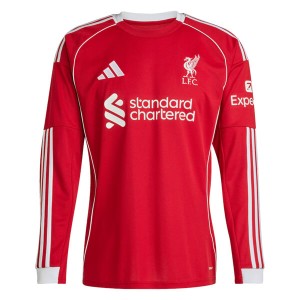
Liverpool Home Long Sleeve Football Shirt 25 26
Furthermore, after the 1989 Hillsborough disaster, two flames were added to the left and right sides of the logo, which commemorate the 96 fans who lost their lives that day. As for the “You’ll Never Walk Alone” anthem, its origin comes from the cover released by Gerry and the Pacemakers in 1963, which topped the UK’s Singles charts for no less than four weeks, and later convinced manager Bill Shankly to adopt the message as the official club’s motto.
What About the Origin of Juve’s Iconic Kit?
Did you ever ponder why Juventus plays in their iconic equipment characterized by black and white stripes? Well, it wasn’t always like this. Founded in 1897 by students of the Massimo d’Azeglio Lyceum, Juventus’s equipment at first was actually pink, as this was the color most easily supplied from the local shops surrounding the playing fields of Borgo Nuovo. However, dyes in that period were not exactly of the highest quality and the equipment had a tendency to look worn out after only a couple of washes, which was not exactly ideal for a club that joined the Italian football championship only three years after its inception.
An alternative was needed, which is why John Savage, Juve’s first foreign player, contacted one of his acquaintances at the Shaw and Shrewsbury tailoring company in Nottingham, who sent a set of kits identical to those of his former club, Notts County, the oldest football club in the world. The change was permanent, and since 1903, Juventus has played in black and white. In fact, in order to celebrate the century-old history between the two clubs, Notts County was invited by Juventus to play the inaugural match on the 41,000-seat Juventus Arena, built on the site of the old Stadio delle Alpi.
Leave A Comment